
How to choose the right Anand viscoplastic model for solder joint thermomechanical Finite Element Analysis?


Finite Element Analysis (FEA) is commonly employed to assess the reliability of solder joints subjected to temperature cycling. To achieve accurate results, an appropriate viscoplastic law is essential for modeling the thermomechanical behavior of the solder alloy. Among the available models, the Anand viscoplastic model has been extensively utilized for FEA simulations of SAC305 solder joints. Consequently, numerous studies have focused on determining its nine parameters [1-4]:

The Anand viscoplastic model parameters can vary significantly for the same solder alloy depending on the experimental methodology used. Researchers should design experiments to closely mimic the conditions that solder joints experience during their lifecycle. The closer the experimental conditions match real-world scenarios, the more accurate the resulting Anand viscoplastic model will be. Two key factors must be considered, the representativeness of the test sample and the thermomechanical loading conditions:
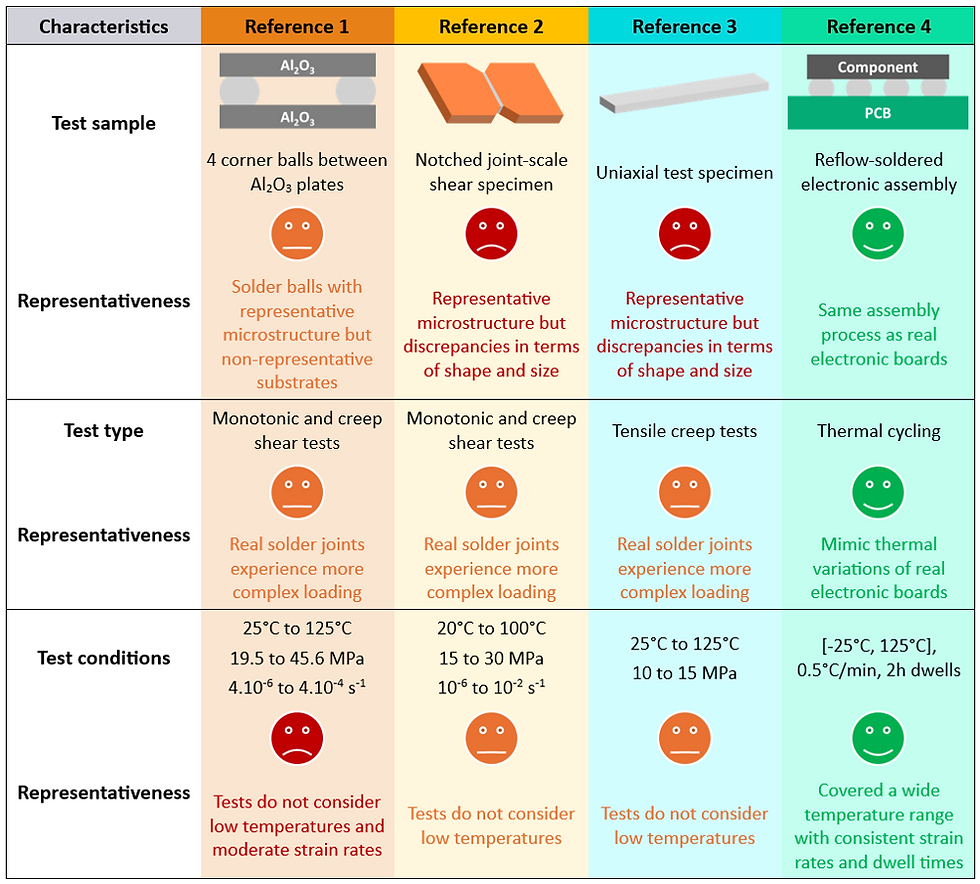
One approach to evaluate the accuracy of different Anand viscoplastic models is to compare experimental data with FEA simulation results. A representative test vehicle, comprising a component reflow-soldered onto a standard multilayer Printed Circuit Board (PCB), was instrumented to capture the experimental hysteresis loop, illustrating the evolution of shear stress and strain in SAC305 solder joints during temperature cycles between 0°C and 100°C:

The test vehicle and temperature cycling conditions were modeled in Finite Element software (Ansys Workbench) to compare the numerical hysteresis loops generated by each SAC305 Anand viscoplastic model with the experimental loop:

The numerical shear strain-stress hysteresis loops, while representing the same solder alloy, show significant discrepancies, with some deviating substantially from the experimental hysteresis curve. This highlights the critical importance of selecting a relevant Anand viscoplastic model for simulating solder joints under thermal cycling conditions. It is also important to note that the curve-fitting process itself contributes to the variability of the obtained Anand parameters.
What is important to remember is that engineers performing reliability analysis should select an Anand viscoplastic model derived from experimental conditions that closely match the real-world operating conditions of electronic boards.
[1] K. Mysore, G. Subbarayan, V. Gupta, R. Zhang, "Constitutive and aging behavior of Sn3.0Ag0.5Cu solder alloy", IEEE Transactions on Electronics Packaging Manufacturing, Vol. 32, No. 4, pp. 221-232, 2009.
[2] D. Herkommer, J. Punch, M. Reid, "Constitutive modeling of joint-scale SAC305 solder shear samples", IEEE Transactions on Components, Packaging and Manufacturing Technology, Vol. 3, No. 2, 2013.
[3] M. Motalab, M. Basit, J.C. Suhling, "Creep test method for determination of Anand parameters for lead free solders and their variation with aging", ITherm conference, pp. 127-142, 2014
[4] J-B. Libot, Z. Bussière, L. Mahfouz, J. Alexis, O. Dalverny, "Anand model calibration for SAC305 solder joints based on the evolution of the shear stress and strain hysteresis loops for different thermal cycling conditions", EuroSimE conference, 2023.


Comments